
The Reserve Bank on Friday retained inflation projection at 4.5 per cent for the current financial year, lower than 5.4 per cent in the last fiscal. Assuming a normal monsoon this year, CPI (consumer price index-based) inflation for the current year is projected at 4.5 per cent, with Q1 at 4.9 per cent, Q2 at 3.8 per cent, Q3 at 4.6 per cent, and Q4 at 4.5 per cent.

The Reserve Bank has found gaps in banks' corporate governance despite issuing guidelines on the matter, Governor Shaktikanta Das said on Monday. Addressing directors of bank boards, Das said such gaps, which have been mitigated, could have caused "some degree of volatility". He also hit out strongly against "smart accounting" to conceal stress and bloat financial performance.

'I think today RBI supervision is much sharper than what it was earlier.'

The Reserve Bank of India on Friday decided to keep the policy rate unchanged for the 11th time in a row but sharply lowered the GDP growth forecast to 6.6 per cent for the current fiscal, as against earlier projection of 7.2 per cent. The Reserve Bank of India (RBI) maintained the status quo on interest rate despite July-September quarter GDP growth falling to 7-quarter low of 5.4 per cent, as against its own projection of 7 per cent.

The RBI is fully aware that the high-cost loans and high indebtedness of the borrowers could pose financial stability risks, if not addressed by these NBFCs. Governor Shaktikanta Das has issued a stern warning, saying the RBI is closely monitoring these areas and will not hesitate to take appropriate action, if necessary, if the culprits don't opt for self-correction. Watch out for some action, soon, notes Tamal Bandyopadhyay.

Reserve Bank Governor Shaktikanta Das on Friday said 67 per cent of the decline in the foreign exchange reserves since April was due to valuation changes arising from strengthening US dollar and higher American bond yields. The forex reserves, which stood at $606.475 billion as on April 2, have declined to $537.5 billion as on September 23. It was also the eighth straight week when the reserves declined.

The Reserve Bank's rate setting panel on Thursday met to finalise a report for the government on why it failed to keep retail inflation below the target of 6 per cent for three consecutive quarters since January this year, said sources. The report will be presented to the government as per the Reserve Bank of India Act, they added. The six-member Monetary Policy Committee (MPC) is headed by Governor Shaktikanta Das.

The gap between credit and deposit growth in the banking system is expected to decline sharply to 80 basis points (bps) in the next financial year from an average of 386 bps over the FY22-Q3FY25 period, according to rating agency India Ratings. This would be against the backdrop of sharp moderation in the incremental loan deposit ratio (LDR) of the Indian banking system to 85 per cent in February 2025 from 117-118 per cent in the same month of 2024.

The Reserve Bank on Wednesday announced the increase of the UPI Lite wallet limit to Rs 5,000 and per-transaction limit to Rs 1,000, in order to encourage wider adoption of the popular instant payment system through mobile phones. A limit of Rs 500 per transaction and an overall limit of Rs 2,000 per UPI Lite wallet, is presently applicable, with the facility of auto-replenishment. Unveiling the October bi-monthly monetary policy, Reserve Bank Governor Shaktikanta Das also said the per-transaction limit in UPI123Pay will be enhanced to Rs 10,000 from the current Rs 5,000.

The Reserve Bank of India on Friday decided to keep benchmark interest rate unchanged at 4 per cent but maintained an accommodative stance even as the economy is showing signs of recovery after the second Covid wave.
'The central bank has highlighted that the slowdown in growth has been limited to a few sectors and overall growth is expected to pick up in the second half of the year.'

The Reserve Bank on Friday raised the inflation projection for current fiscal year to 4.8 per cent from 4.5 per cent with Governor Shaktikanta Das saying lingering food price pressures are likely to keep headline inflation elevated in the December quarter. Consumer price index (CPI)-based inflation increased sharply in September and October 2024 led by an unanticipated increase in food prices.

Sir Osborne Smith was the first governor of the Reserve Bank, serving from April 1, 1935, to June 30, 1937.

From CEOs to RBI governors, cricket's rich imagery and strategy resonate deeply with leadership, uncertainty, and decision-making across industries and global diplomacy, points out Suveen Sinha.

Days after the government said the Reserve Bank will introduce a digital currency in 2022-23, Governor Shaktikanta Das on Thursday said the central bank does not want to rush and is carefully examining all aspects before introduction of the Central Bank Digital Currency (CBDC). He, however, declined to give any timeline for the launch of the CBDC. In her Budget 2022-23 speech, Finance Minister Nirmala Sitharaman had announced that the RBI will introduce a digital currency in the next financial year beginning April 2022 to boost the digital economy and for more efficient currency management.
The government on Tuesday appointed three external members -- Ram Singh, Saugata Bhattacharya and Nagesh Kumar -- to the RBI's rate-setting Monetary Policy Committee for four years. The central government has reconstituted the Monetary Policy Committee (MPC) of RBI, the finance ministry said in a statement. Ram Singh is the director of the Delhi School of Economics, Saugata Bhattacharya is an economist, and Nagesh Kumar is the director and Chief Executive, Institute for Studies in Industrial Development, New Delhi.
Reserve Bank Governor Shaktikanta Das will hold a meeting with CEOs of public sector banks on Wednesday to discuss issues concerning slow deposit growth and sustainability of high credit demand. As per the Reserve Bank of India (RBI) data, deposits rose by 9.6 per cent as compared to 10.2 per cent on a year-on-year basis, while credit offtake witnessed a jump of 17.9 per cent as against 6.5 per cent a year ago. According to an agenda circulated for the meeting, sources said, sustainability, including pricing and slow growth of deposits, would be discussed.
The Reserve Bank of India on Wednesday kept the benchmark interest rate unchanged at 4 per cent and decided to continue with its accommodative stance against the backdrop of concerns over the emergence of the new coronavirus variant Omicron.

RBI Governor Shaktikanta Das on Friday said the entry of big tech firms into the financial sector poses systemic concerns like overleveraging at the borrowers' ends.
The Reserve Bank of India on Wednesday expectedly left interest rates unchanged and maintained an accommodative stance as the economy faces a renewed threat to growth due to the resurgence of coronavirus cases.

To ease the potential liquidity stress, the Reserve Bank on Friday slashed Cash Reserve Ratio (CRR) by 50 basis points to 4 per cent, a move that would unlock Rs 1.16 lakh crore bank funds. The RBI on May 4, 2022 had raised CRR to 4.5 per cent from 4 per cent in an off-cycle Monetary Policy Committee (MPC) meeting, with effect from May 21 the same year.

The RBI Board on Friday approved the transfer of Rs 57,128 crore as surplus to the central government for the accounting year 2019-20, the central bank said in a statement.

The Reserve Bank of India on Friday decided to keep the policy rate unchanged at 6.5 per cent for the fifth time in a row as it maintains a tight vigil on inflation. The rate increase cycle was paused in April after six consecutive rate hikes, aggregating to 250 basis points since May 2022. Announcing the bi-monthly monetary policy, RBI Governor Shaktikanta Das said the Monetary Policy Committee (MPC) unanimously decided to keep the repo rate unchanged at 6.5 per cent.
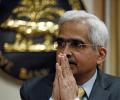
Reserve Bank Governor Shaktikanta Das on Wednesday ruled out upside risks to the 5.3 per cent inflation forecast for the current fiscal, saying the recent cut in excise duty on diesel and petrol as well as better management of supply-side issues on the food front have contained inflationary expectations. These measures are significantly positive for inflation management, he said. After months of calls for reducing taxes on fuels, the government, last week, cut the excise duty on diesel and petrol by Rs 10 and Rs 5 per litre, respectively.
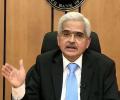
Reserve Bank of India (RBI) Governor Shaktikanta Das has said the decision on interest rate moderation will be based on long-term inflation trajectory and not monthly data. The Monetary Policy Committee (MPC) headed by the RBI Governor is scheduled to meet between October 7 and 9 and take call on interest rate. The RBI kept the repo rate unchanged at 6.5 per cent for the ninth time in a row amid risks from higher food inflation.

Of the eight RBI governors who have held office since the 1991 economic liberalisation, Bimal Jalan had the longest stint and S Venkitaramanan, the shortest. Current Governor Shaktikanta Das will overtake Bimal Jalan before completing his second term in December, points out Tamal Bandyopadhyay.

In a tightening cycle, a premature pause in monetary policy action would be a costly policy error, Reserve Bank Governor Shaktikanta Das opined while voting along with five other members of the MPC for raising the key lending rate by 35 basis points earlier this month, according to the minutes of the meeting released on Wednesday. Prior to the December hike in repo rate, the RBI had raised the key short-term lending rate by 190 bps in four tranche.

He said the transformation brought about by the fintech sector in India is not just limited to technology, but its social impact is far-reaching. He also stressed that fintech has dented the parallel economy and is bridging the gap between villages and cities on the financial services front. The prime minister also said that in the last 10 years, the fintech space has attracted investments of more than $31 billion and fintech startups have grown by 500 per cent.

The Reserve Bank of India on Friday slashed the growth projection to 7 per cent for the current fiscal from the earlier forecast of 7.2 per cent, citing aggressive tightening of monetary policies globally and moderation in demand. Unveiling the fifth monetary policy for this fiscal, RBI Governor Shaktikanta Das said the central bank remains committed to price stability to put the country on the sustained path of growth.

Stating that growth impulses and the fast-moving indicators are strong, Reserve Bank Governor Shaktikanta Das on Wednesday exuded confidence of the economy clipping at the projected 9.5 per cent this fiscal. Giving all the credit for the faster-than-expected recovery of the economy to the government, Das said the central bank has only been supporting the government in reviving the economy ravaged by the pandemic. Citing a slew of measures the government has taken since the pandemic struck in March 2020, the governor specifically mentioned tax cuts on fuels, tax resolution for the telecom sector, annulling of the retro tax legislation, sale of Air India, plans to sell some of the public sector banks and PLI scheme as the major reforms and growth-drivers bearing fruits now.
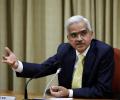
Reserve Bank Governor Shaktikanta Das on Wednesday said the country is at the doorstep of economic revival on the back of accommodative monetary and fiscal policies being pursued by the central bank and the government.
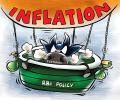
The Reserve Bank on Wednesday retained the retail inflation projection at 4.5 per cent for fiscal 2024-25, with Governor Shaktikanta Das stressing that the central bank will have to closely monitor the price situation and keep the "inflation horse" under tight leash lest it may bolt again. Unveiling the October bi-monthly monetary policy, the Governor also said the flexible inflation targeting (FIT) framework has completed 8 years since its introduction in 2016 and is a major structural reform of the 21st century in India.

The Reserve Bank of India on Thursday opted for a pause second time in a row, maintaining key benchmark policy rate at 6.5 per cent as inflation moderates. The rate increase cycle was paused in April after six consecutive rate hikes aggregating to 250 basis points since May 2022. Announcing the bi-monthly monetary policy, RBI Governor Shaktikanta Das said the Monetary Policy Committee (MPC) unanimously decided to keep the rate unchanged at 6.5 per cent.
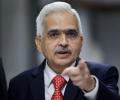
The Reserve Bank of India on Friday decided to keep the policy rate unchanged for fourth time in a row as it maintains a tight vigil on inflation. The rate increase cycle was paused in April after six consecutive rate hikes aggregating to 250 basis points since May 2022. Announcing the bi-monthly monetary policy on Friday, RBI Governor Shaktikanta Das said the Monetary Policy Committee (MPC) unanimously decided to keep the repo rate unchanged at 6.5 per cent.
Reserve Bank of India (RBI) Governor Shaktikanta Das on Sunday said he has tested positive for coronavirus and will work from isolation while the central bank will continue to function normally. Das said he is asymptomatic and has alerted those who came in contact with him in recent days.

Private sector bank board members have urged the Reserve Bank of India (RBI) top brass to consider workload management of the boards as they feel there are too many issues that go to the boards for approval and the situation becomes unmanageable at times. The views were conveyed to the regulator on Monday in a conference of directors of private sector bank boards on the theme "Transformative Governance Through Sound Boards". RBI governor Shaktikanta Das, deputy governors Swaminathan J and M Rajeshwar Rao, and other senior officials of the central bank participated in the conference.
The Reserve Bank of India on Friday retained its projection for retail inflation at 4.5 per cent for the current fiscal assuming a normal monsoon, while emphasising that uncertainties related to food price outlook warrant a close monitoring. Consumer Price Index (CPI)-based retail inflation has been projected at 4.5 per cent with quarter-wise projections at 4.9 per cent in Q1 (April-June), 3.8 per cent in Q2, 4.6 per cent in Q3, and 4.5 per cent in Q4.

The police said that the threat email was sent from the accused, Mohammed Arshil's ID.
The highlights of RBI's bi-monthly monetary policy announced by Governor Shaktikanta Das:

The Reserve Bank on Thursday tightened norms for consumer credit as it asked banks and NBFCs to assign a higher risk weight for unsecured personal loans, a move aimed at making the lenders more cautious on such advances. The risk weight on unsecured consumer loans has been raised by 25 percentage points. The new regulations, however, will not be applicable on housing loans, education loans, vehicle loans and loans secured by gold and gold jewellery, the Reserve Bank said in a circular.
